DARQA

Author: darqa-admin

  • Newly released OECD Position Paper on Good Laboratory Practice and IT Security

    This week the OECD published the OECD Position Paper on Good Laboratory Practice and IT Security (No 25)

    Data generated according to Good Laboratory Practice (GLP) are increasingly generated and retained in electronic format. Measures of IT security aim to protect electronic GLP data and applications against the specific hazards encountered in the computerised environment. Threats and attacks on systems containing GLP data and corresponding measures to ensure security of such systems are constantly evolving, especially for systems and services being provided over or interfacing the internet. Handling of IT security may be outsourced by test facilities to external service providers. However, the responsibility remains with the test facility. This position paper provides an overview of considerations regarding IT security and GLP test facilities.


    It is available following this link:

    https://www.oecd.org/content/dam/oecd/en/publications/reports/2024/12/oecd-position-paper-on-good-laboratory-practice-and-it-security_9772eecf/910b7bd2-en.pdf

  • Latest news on OECD Chemical Safety

    New reports on good laboratory practice

    The principles of Good Laboratory Practice (GLP) are applied in the performance of tests to obtain data on the properties and hazards for people, animals and the environment of any chemical substance. The purpose of these tests is to submit the substances studied to the regulatory authorities responsible for their official registration as a preliminary step to marketing. This guarantees the reliability, integrity and quality of data generated for regulatory purposes so that they can be used by chemical assessment authorities and be recognised internationally without the need to reproduce the studies.

    The OECD provides practical guidance to OECD member and partner countries on the structure, mechanisms and procedures they should adopt when establishing national Good Laboratory Practice compliance monitoring programmes. The OECD recently published the two following guidance documents: 

    • An Advisory Document on Quality Assurance and GLP which sets out some rules and standards to ensure that the Quality Assurance (QA) program in test facilities including risk-based QA approach to ensure processes and data collected are accurate and properly documented in accordance with Good Laboratory Practice. 

    • A Position Paper on Quality Improvement Tools and GLP that provides an overview of available quality improvement tools that might be considered for GLP and their role and operation when used in test facilities.

    Access the advisory document

    Access the position paper

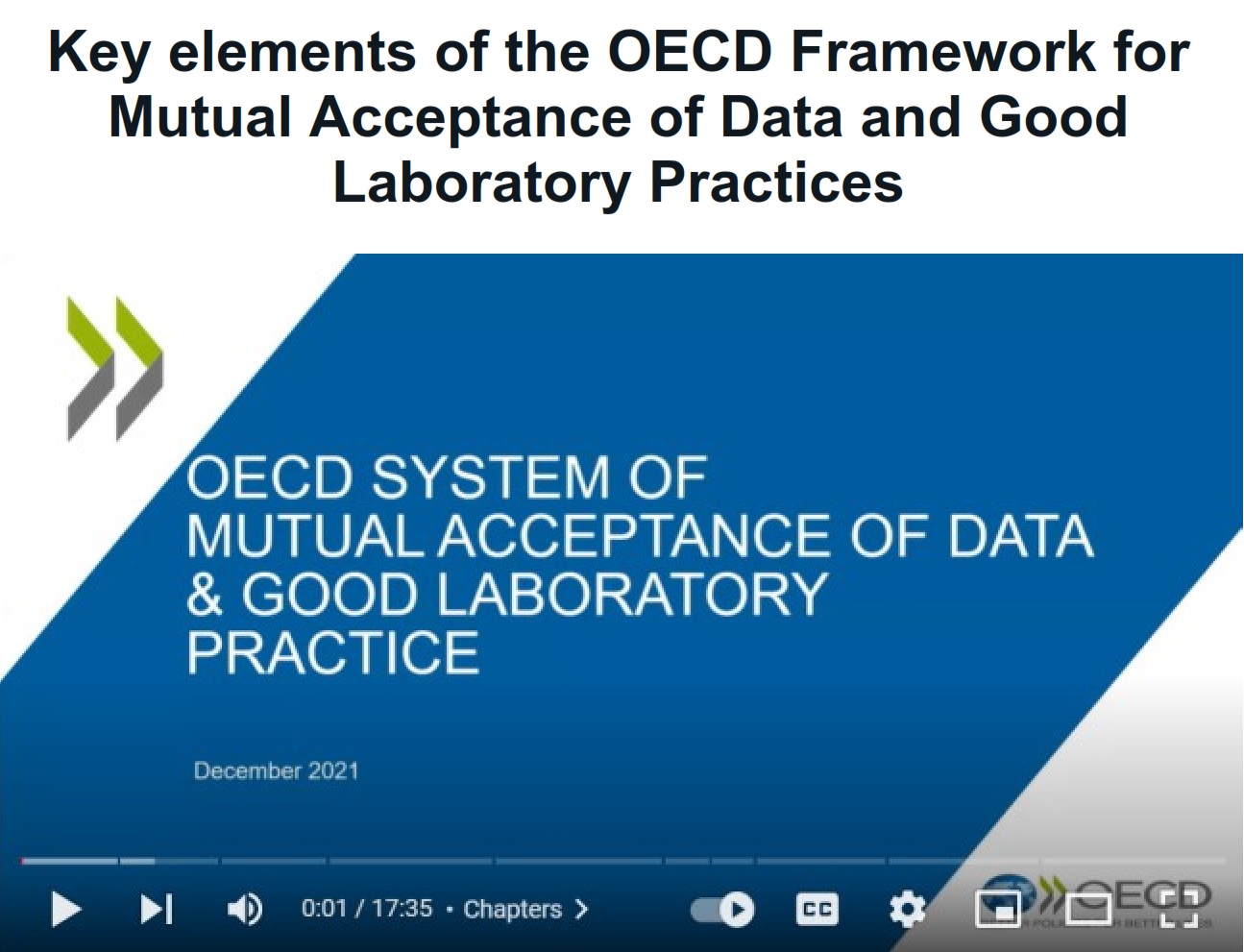
  • Key elements of the OECD Framework for MAD and GLP

    Key elements of the OECD Framework for MAD and GLP


    Mutual acceptance of data


    This video recording provides an overview of the OECD’s Mutual Acceptance of Data (MAD) framework as well as the OECD Principles of Good Laboratory Practice. The framework ensures the quality of non-clinical safety studies and reduces duplication of testing. It is useful for countries who are considering to become adherents to the MAD framework, which includes non-OECD countries.

  • DARQA/RQA European QA Symposium

    DARQA/RQA European QA Symposium, 20 and 21 May 2021

    The Future of Quality: What’s keeping you awake at night?

    The European QA Symposium 2021, a collaboration between DARQA and RQA, is an innovative new event designed to meet the needs of QA professionals in the life sciences, medicines, medical devices, and food/feed sectors.

    The programme has been developed to reflect regulatory changes, the changing nature of regulatory inspection and auditing, and the evolving structure and needs of industry. As such, the event will be delivered online, direct to the homes and workplaces of QA professionals.

    The event will run over one and a half days, using multiple streams, varied session formats and leading experts to offer a varied programme to suit a European audience.

    In addition, the event will offer opportunities for delegates to meet with exhibitors, network with industry peers, and chat with friends, colleagues and new acquaintances. With online social activity to cement those relationships.

    Please follow the links below to view the programme and to book as a delegate.

    Programme: 
    https://www.therqa.com/learning/european-qa-symposium-2021/european-qa-symposium-2021-programme/

    Booking Page:
    https://www.therqa.com/learning/events/seminar/2021-eu-qa-symposium/

    DARQA members can attend the Symposium at a discount. Please email to voorzitter@darqa.org to obtain the discount code.


  • DARQA webinar “Remote site audits”, 9 oktober 2020

    Op vrijdag 9 oktober jl. vond een webinar plaats met als onderwerp “Remote site audits”, op initiatief van de GCP-commissie.

    De video gemaakt tijdens deze webinar is op het ledengedeelte van deze website te bekijken via deze link.

    Na een introductie door Eveline Krijger, bestuursvertegenwoordiger van de GCP-commissie, is Coree Forman (Q-Star Consulting) de eerste presentator. Zij bespreekt de huidige wet- en regelgeving wat betreft het uitvoeren van audits op onderzoekslokaties tijdens de Covid-19 pandemie. Dat doet zij aan de hand van de regelgeving van FDA en EMA. Die regelgeving is van een paar maanden geleden, toen het coronavirus pas rond waarde. Toen werd er nog van uit gegaan dat het uitvoeren van audits op onderzoekslokaties op een laag pitje zou komen te staan om te voorkomen dat die lokaties onnodig belast zouden worden of per ongeluk besmet zouden worden tijdens het uitvoeren van een audit. EMA adviseerde om geen audits op onderzoekslokaties uit te voeren en heeft dit advies nog niet veranderd. De FDA blijkt meer open te staan voor mogelijkheden wat betreft de verificatie van studie- en patientendata op afstand.

    Inmiddels is duidelijk dat het uitvoeren van audits op onderzoekslokaties weer doorgang vindt, zoals Frank Smeets van GSK als tweede presentator beschrijft. Frank vertelt hoe de overgang van het ter plaatse uitvoeren van audit naar het op afstand uitvoeren van een audit het noodzakelijk maakt dat de lokatie die wordt uitgekozen om te worden geaudit nóg belangrijker is dan voorheen omdat met andere omstandigheden rekening moet worden gehouden, waaronder de plaatselijke wet- en regelgeving: of die het wel toestaat een audit op afstand uit te voeren. Op basis van de aanwezige informatie/data wordt een aantal lokaties uitgekozen.


    (more…)

  • GLP and Brexit

    GLP and Brexit

    Brexit – guidance to stakeholders on impact in the field of Good Laboratory Practice (GLP), Published on: 28/06/2019brexitUK

    In view of the uncertainties surrounding the ratification of the Withdrawal Agreement, all interested parties, and especially economic operators, are reminded of legal repercussions, which need to be considered when the United Kingdom becomes a third country.

    This document analyses the legal consequences of the United Kingdom’s withdrawal on Good Laboratory Practice (GLP).


    See also:

    the Practical guidance for procedures related to Brexit for medicinal products for human use approved via MRP/DCP and Questions & Answers.

    EMA: Brexit-related guidance for companies

  • Verslag DARQA Themadag 12 april 2019

    VERSLAG DARQA THEMADAG 12 APRIL 2019

    ”HOE HOUD JE JE ALS MENS STAANDE IN DE GEREGULEERDE QA OMGEVING?”

    Lokatie: Best Western Berghotel, Amersfoort

    1. Opening

    Marijke Steenvoorde opent de themadag en heet alle aanwezigen welkom. Zij introduceert vervolgens de eerste spreker van de dag, Henrieke de Bie.

    1. The influence of (organisational) culture on quality

    Presentatie door Henrieke de Bie, ProPharma Group

    Henrieke is vorig jaar afgestudeerd aan de Cranfield University op dit onderwerp. Ze heeft onderzocht of er significante verschillen in kenmerken van een kwaliteitscultuur zijn tussen GCP en GMP-omgevingen. En verrassend genoeg lijken die er niet te zijn. Ook de invloed van de landscultuur lijkt minimaal te zijn, alhoewel deze wel een invloed zal hebben op de manier waarop een kwaliteitscultuur wordt opgebouwd.

    In deze presentatie geeft Henrieke een kijkje in de keuken van de kwaliteitscultuur in een organisatie, met vragen als: “Kan je kwaliteit in een organisatiecultuur inbouwen?” ”Wat is een kwaliteitscultuur in een organisatie en zijn daar indicatoren voor die je kunt meten?”

    (more…)

  • Safety Information from a GCP Perspective


    On Friday, 22 September 2017, a GCP/GPV training day was held with the subject: “Safety Information from a GCP Perspective“.

    The day started with a presentation on “Core concepts in pharmacovigilance auditing” by Marielle Keulen, Xendo. It was followed by presentations which covered different aspects of Safety information which included Reference Safety Information (RSI) from Clinical Trial and Post marketing perspectives, presented by Deepti Naik, PRA Health Sciences and Marielle Keulen.

    Pharmacovigilance aspects which one comes across during day to day GCP or during monitoring was presented by Deepti Naik in her presentation “Safety information at investigator sites” hereby linking GCP and GPV. Final presentation for the day was on “Reference Safety Information from a QA perspective” presented by Laurentiu Chitimia, Astellas. The day concluded with a Q&A session with the speakers of the day.

    (more…)